
A Look Into Sydney Ross Mitchell’s World
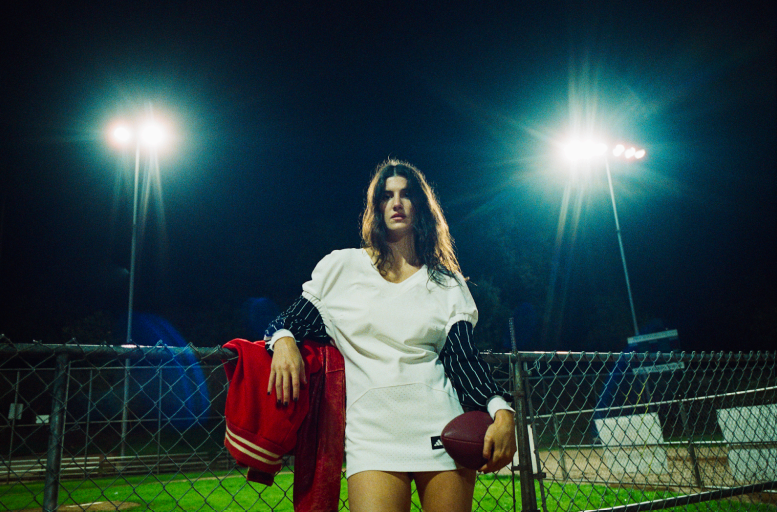
Photo by Cole Silberman
Driven by acoustic guitar and pensive lyrics, Sydney Ross Mitchell's music brings an intimacy and twang to pop music that modern listeners are searching for. “I think that we underestimate people's ability to understand us, and their ability to relate to us,” said Mitchell when I sat down with her to discuss her upcoming EP “Cynthia,” coming out February 6th.
Her two latest singles, “Cynthia” and “Queen of Homecoming” give fans insight into Mitchell’s world. They describe experiences that may feel niche and singular but as anyone who's a devoted listener can tell you, always come out feeling deeply relatable. We chatted about her creative process and the making of “Cynthia.”
Emma O’Keefe: When you're writing a song – where do you start?
Sydney Ross Mitchell: It really depends on the song. Sometimes it really is that magical, all comes to you at once. And then other times, I write parts of stuff, and I'll sit on something for a year if I need to. If I'm waiting for the place where it really belongs. So it's genuinely very different every time, but I would say there's always some sort of words. It comes from more of a lyrical place rather than just some sort of psychic idea for the most part.
EO: Your songs are very intimate and introspective. Does that come naturally to you?
SRM: I find it very easy to just tell people what I feel or what I think. And I don't know if it's been that way my whole life or if it's something that I've sort of taught myself over the years, but I sometimes tell people that I get sort of a thrill out of the feeling of being embarrassed. Like I'm telling people something I should to myself. Something about that feels very exciting to me. I think it teaches you something about yourself. I think it was Austin Butler. He was saying in an interview recently that he thinks embarrassment is an underexplored emotion. I would agree with that. I find it to be something that comes naturally to me, yes, but also is exciting for me, and probably in a slightly masochistic way.
EO: Since they can be so personal, does it ever surprise you that so many people relate to them?
SRM: Absolutely. It shocks me all the time. One of the first songs I ever had a little bit of success with on TikTok that kind of, got me, like, “Oh, wait, maybe, people like my stuff,” was a song called “Porn Star.” I had initially thought it would never see the light of day and I thought I would never show it to anybody because I just couldn't believe I said that. When it started getting some attention, I remember thinking, “Oh, I wish I could tell my parents about this, but I can't, because it's so embarrassing. They're not going to like it.” And then, over time, it kept happening that way, where something would have a little bit of success or get some attention, and I would be like, “Dang it, I don't want to show my parents this” because it feels embarrassing, and then I connected that that was why it was connecting with people, because it was vulnerable, because it felt embarrassing, because it felt like something I wouldn't want my mom and dad to hear. But all of that to say, absolutely, it still shocks me. In my writing, it can be very specific feelings, and they're very sort of ephemeral and cloudy, and it's so big you don't even know what you're looking at and then you try to capture just a little piece of it. So every time that I hear people relate to it, it's fascinating to me. Hearing their take on it, what they thought that it meant also teaches me something. Very shocking, but it makes me very grateful.
EO: How important would you say collaboration is to your creative process?
SRM: In terms of emotional material, I'm pretty protective and I don't write with a lot of people. There's this one writer named Solly (Sarah “Solly” Solovay). She's so incredible and has become a great friend, and she works on a lot of stuff with me. Having her contribute as a songwriter has been incredibly valuable. Something I think was so great about bands and bands like the Eagles, is that they could have a hit regardless of which band member was singing the lead vocal. They were so diversely talented and all of them coming together, and each showing up with their best instinct, made their music so rich and so alive. When I have Mason Stoop's, an incredible guitarist, Taylor Mackall, an incredible pianist, or Remmy Morritt, an incredible drummer. I'm like, I want you to do what you want to do. I will maybe give you notes, but I want you to play what you feel. It's definitely led to an expansion of the musicality in the music that I’ve always wanted it to have.
Music is meant to be made together. People were meant to sing together, people were meant to bang sticks around a fire together. So I really do think it just makes music so much more rich and emotionally dynamic, sonically dynamic. That's something that I'm so specifically proud of on this project. If you listen to my first EP versus this one, I think the development, the maturity of just the musicality, I think, is really obvious. And that's probably what I am the most proud of.
EO: How did you come to decide that “Cynthia” and “Queen of Homecoming” would be the first songs released from the EP?
“Cynthia” and “Queen of Homecoming” were the last two that I wrote, probably in the same week. And it was when I wrote those two that it contextualized the whole thing for me. “Cynthia,” I just felt so strongly about it and just very emotionally connected to it and that was really the choice, was that I really wanted to put it out. I felt very sure of that, and I felt like it set the stage of the emotional material the best.
For “Queen of Homecoming,” I think the emotional context is relevant. The holidays are not just happy and shopping and scented candles. Sometimes, being around your family and going home can be hard. It brings up a lot of memories. It makes you face yourself. You’re always gonna be 17 in your hometown. When I'm with my brothers, my two older brothers will always be my older brothers, no matter how old I get. My little brother will always be my little brother. So I was like, I think we can put it out this time of year because I think people will be tapped into that feeling.
This interview was condensed for clarity.